Post-quantum provenance and temporal attestation

Attest any digital object.

Ghoststamp proves a digital object is what it claims to be, to anyone, without them having to trust us or whoever stored it. It runs on your own machine. The record verifies offline.

The problem

Time is a universal dependency.
Nothing verifies it.

Everything in a computer system rests on timestamps: caches, database rows, log entries, tokens, certificate validity windows. They are the backbone of what happened when. If you can manipulate one, you can distort perceived reality inside a machine.

01. Audit logs can be reordered. An actor who controls the system clock can fool a log into the wrong order of operations, or rewind a backup to overwrite newer data.
02. Expired requests come back. A request valid for ten minutes is revived by replaying it against a manipulated clock. In financial systems this is catastrophic.
03. Custody becomes unprovable. A false chain of custody in forensic evidence, a backdated contract, a patent record that cannot be defended years later.
04. The clock is an injection point. Through log poisoning, a manipulated time server, or a hypervisor clock the host controls. It does not need to be attacked directly.
01WORKFLOW 02DEPENDENCY 03TAMPERING 04CONSEQUENCE

Six steps, one timeline.

After a suspected breach an analyst collects the logs and hashes them, normalizes every source to UTC, correlates them, builds a timeline, finds initial access and reports.

Every step reads the clock.

Normalization can correct an offset it knows about. It cannot detect one that is a lie. Ordering, dwell time and first access are all derived from timestamps nothing verifies.

The clock is what was attacked.

Through a manipulated time server, log poisoning, or a hypervisor clock the host controls. It never has to be touched directly.

The audit inherits the compromise.

The log that would catch it takes its timestamps from the same source, including the record of when the log itself was written.

No step can detect it.
01 COLLECT 02 NORMALIZE × cannot detect a lie 03 CORRELATE 04 TIMELINE 05 INITIAL ACCESS × earliest entry can be forged 06 REPORT SYSTEM CLOCK MANIPULATED
  1. 01 Collect and hash
  2. 02 Normalize to UTC
  3. 03 Correlate sources
  4. 04 Build the timeline
  5. 05 Find initial access
  6. 06 Report findings

Every one of these reads its time from the same clock.

And the audit log that would catch any of it is written by the same clock.
Where this belongs

Provenance is the next operating system service.

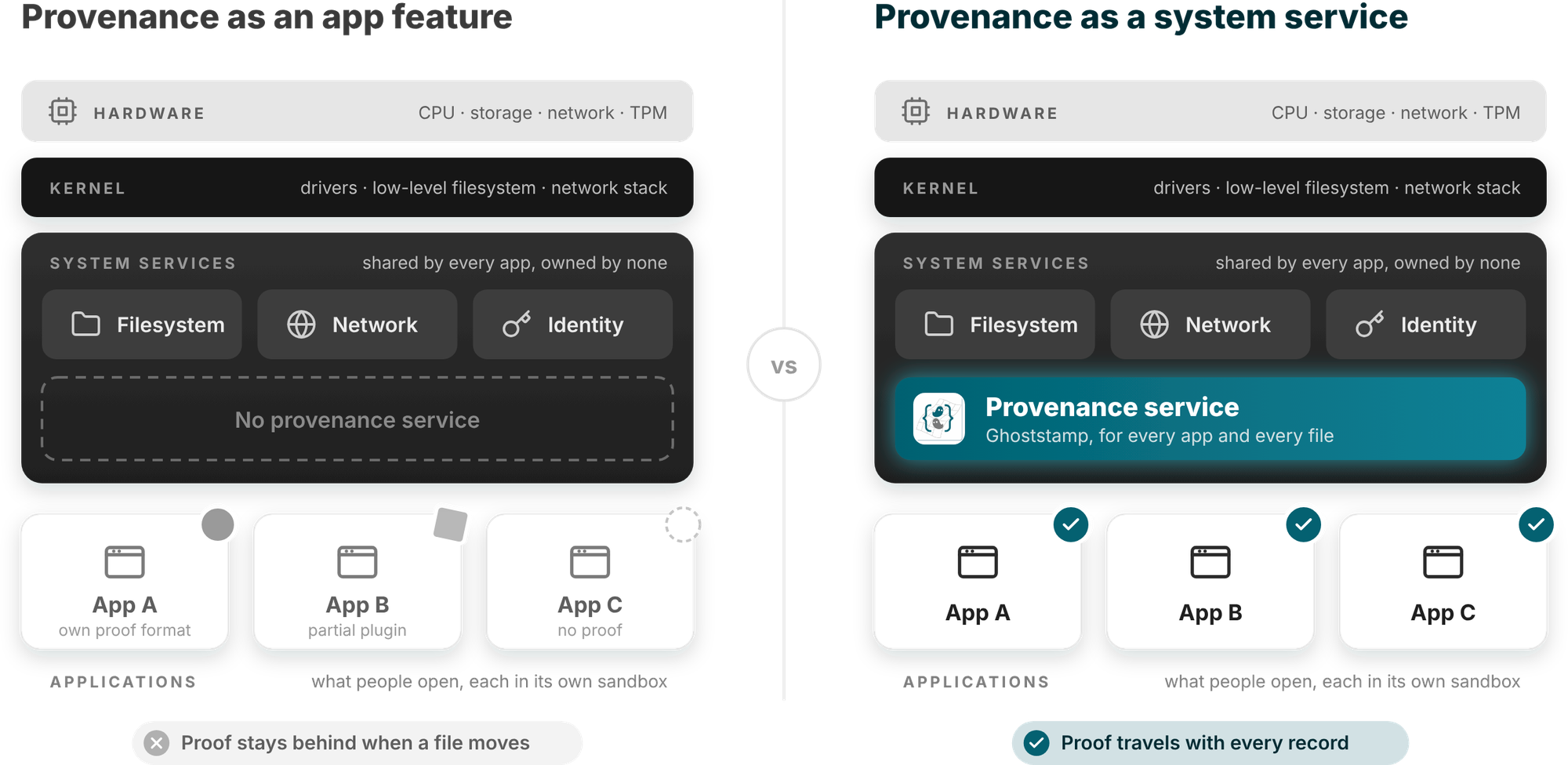
Storage became a service every application could assume rather than build. Connectivity followed, then identity. Provenance never did, so every application invents its own proof format, and the proof stays behind when the object moves.

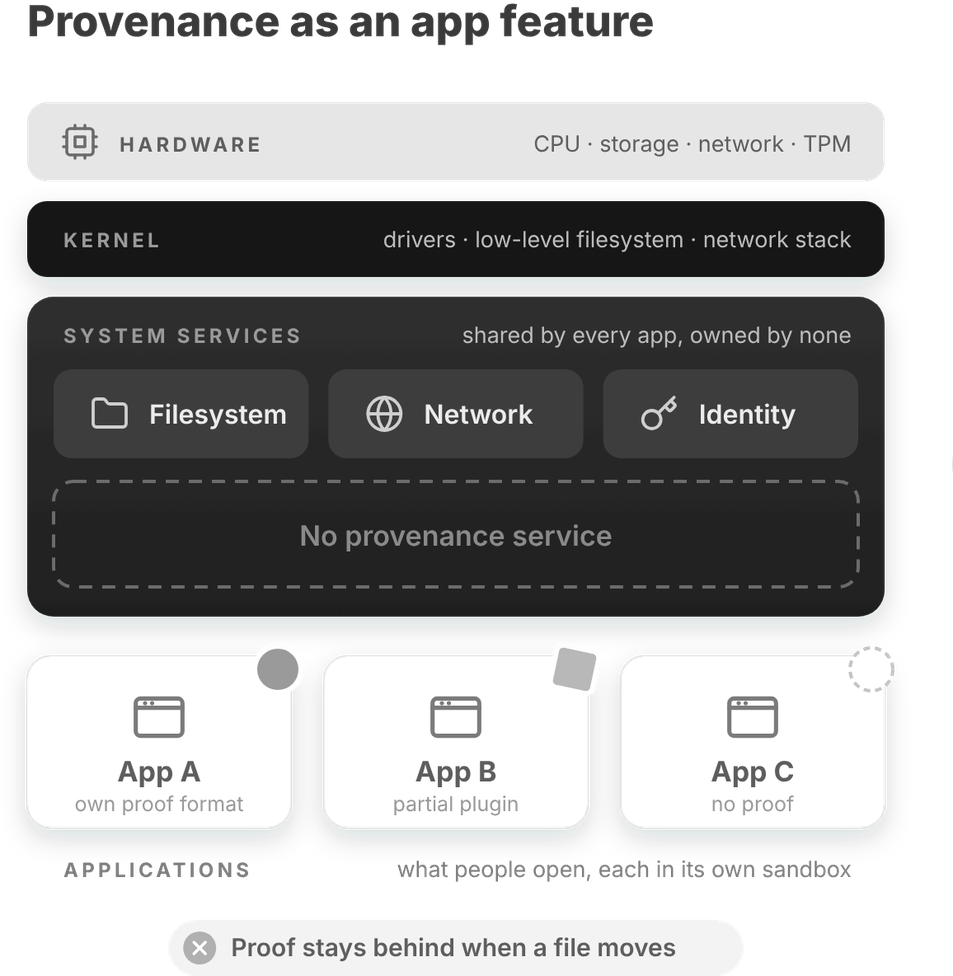
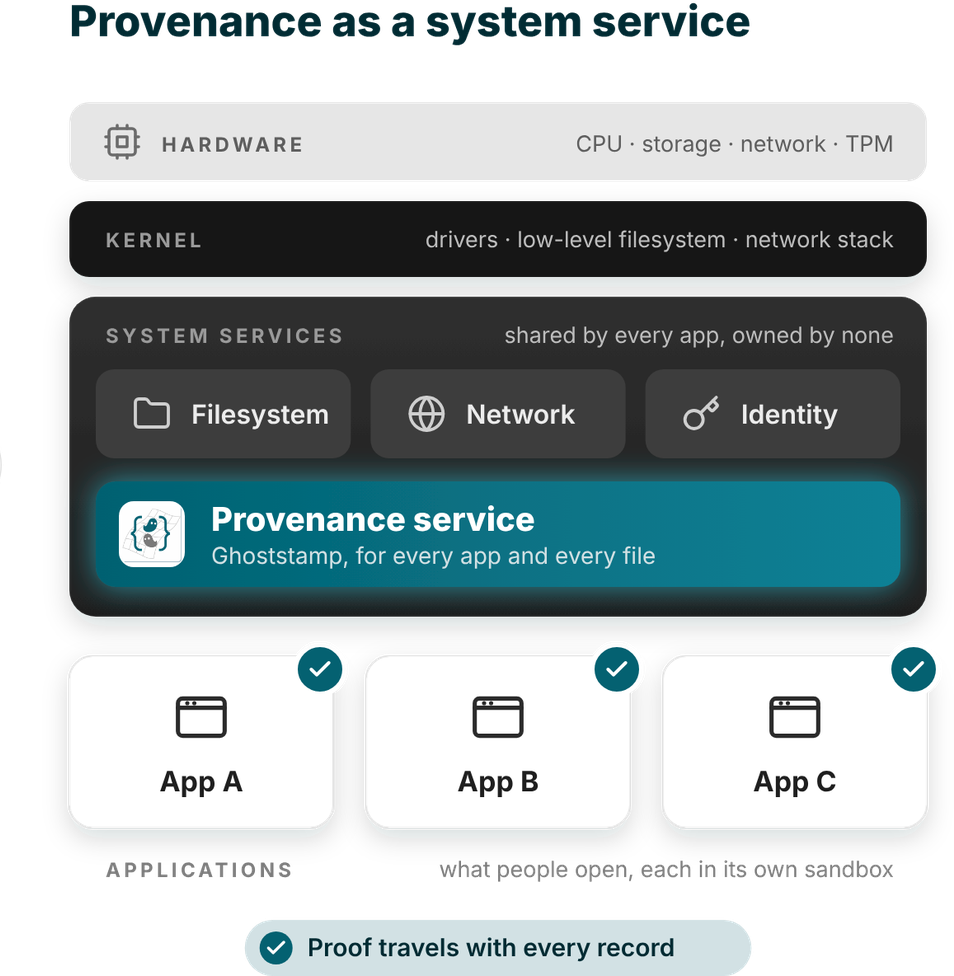
Two stacks compared. On the left, provenance as an app feature: hardware, kernel, then system services holding filesystem, network and identity, with no provenance service. Each application invents its own proof, so proof stays behind when a digital object moves. On the right, provenance as a system service: the same stack with Ghoststamp added alongside filesystem, network and identity, so every application is attested and proof travels with every record. Provenance as an app feature. Hardware, kernel, then system services holding filesystem, network and identity, with no provenance service. App A uses its own proof format, App B a partial plugin, App C has no proof. Proof stays behind when a digital object moves. Provenance as a system service. The same stack with Ghoststamp added alongside filesystem, network and identity. Apps A, B and C are all attested, and proof travels with every record.
See it run

Every object carries its anchor.

Every attested object carries a local ledger frame and the remote frame it was anchored to. Open any record and the full provenance is there: the digest, the post-quantum signature, the inclusion proof and the frame it belongs to.

No account. No upload. The object never leaves the machine.

Ghoststamp 1.2.5 · attested objects and provenance records
Verification

Four gates, in order, offline.

A recipient verifies a record with no server to call, no account, and no issuer that has to still exist.

01HASH 02INCLUSION 03FRAME 04SIGNATURE

Hash integrity

The object is hashed and the digest compared to the one in the record, before anything else runs. A forged or stolen signature cannot validate a modified object.

Inclusion proof

The digest is proven to sit in the Merkle root the record names, so the object belongs to that batch and not merely alongside it.

Frame hash

The root is proven to sit in a sealed ledger frame at a fixed position in sequence. Position is what makes the ordering meaningful.

Post-quantum signature

The frame is verified under ML-DSA-87 with SHA-512, on a CNSA 2.0 profile. Only now does a signature get evaluated at all.

Verified, failed, or incomplete. Never a guess.
OBJECT + RECORD GATE 1 HASH INTEGRITY GATE 2 INCLUSION PROOF GATE 3 FRAME HASH GATE 4 SIGNATURE VERIFIED
  1. G1 Hash integrity
  2. G2 Inclusion proof
  3. G3 Frame hash
  4. G4 Signature

All four must pass, in order, with no server to call.

A gate that fails stops the gates after it.
Where everyone else stands

The category has a hole in the middle.

Four groups touch this problem. Each solves part of it and leaves the customer holding a dependency.

A record,
not a component
Nothing to call
to verify
No vendor
in the path
Post-quantum
by design
Any app,
any object
Timestamping authoritiesRFC 3161 providers
Provenance ledgersNational and institutional
Post-quantum componentsCores and libraries
Media provenanceContent credentials, written by the app
GhoststampA system service, patent pending

The nearest competitor is a decade old and still asks the customer to depend on the company that issued the proof.

Who needs it

Anyone who has to defend a record later.

Supply chain

Custody that survives the journey

Route approvals and custody events attested from sensor to screen, verifying in denied and air-gapped environments where nothing can be called.

Software

Proof of what the build produced

Attestation that certifies the artifact rather than the runner that made it, with each record carrying its own place in a tamper-evident sequence.

Evidence and AI output

Records that hold up years later

A provenance record that can be checked by a party who does not trust the producer, and that does not depend on an issuer still being in business.

What is actually built

Pilot-ready, and the proofs are machine-checked.

8
EasyCrypt proof files
24
Machine-checked results
0
Admitted goals
TRL 6
Pilot-ready todayDoD TRA Guidebook, Feb 2025, Table 2-2

The cryptographic core runs ML-DSA-87 with SHA-512 on a CNSA 2.0 profile, selected at run time from external configuration rather than compiled in. A running ledger has already moved from one post-quantum signature profile to a stronger one with no data loss and no interruption, and records signed under the earlier profile still verify, because every record names the algorithms it used.

Get in touch

Bring us an object you need to defend.

Ghoststamp is built by Stellar Quanta Labs, a service-disabled veteran-owned small business near Fort Bragg, North Carolina. Briefings, evaluations and pilot discussions are welcome.